


In This Article
Google AI Mode has passed 1 billion monthly users. Queries have more than doubled every quarter since launch, and Gemini now powers the answer by default.
For SEO, Google AI Mode changes the perspective. Keyword rankings still matter, but a citation inside the answer matters just as much now, if not more.
Google AI Mode search pulls from multiple sources, synthesises a single answer, and chooses which brands get named inside it. Search Console reports AI Mode impressions separately from the traditional results page, proof that Google wants this measured properly.
Below, we explain what Google AI Mode is, how it works, and the steps you can take to help your brand appear among its recommendations.
What Is Google AI Mode?
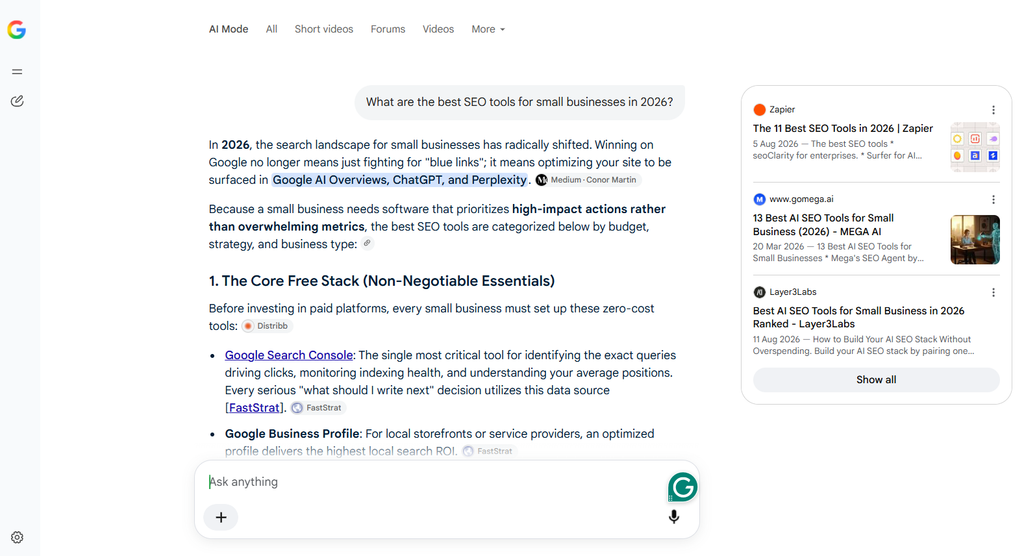
Google AI Mode is a conversational search experience, built on Gemini, housed inside Google’s main search product rather than as a separate destination. A user types or speaks a longer, more open-ended question. AI Mode reasons across it, retrieves from multiple sources, and returns a single synthesised answer with supporting links.
The big difference from AI Overviews is that the conversation can continue. Users can ask a follow-up, share a photo, or take the question in a new direction without starting over. It feels less like getting a one-off search result and more like talking something through.
If you’re not familiar with Google AI Mode, here’s what it looks like:
How Google AI Mode Works
Google AI Mode uses retrieval-augmented generation. When a user enters a query, Gemini breaks it into smaller sub-questions – a technique Google calls query fan-out. Each sub-question triggers its own search behind the scenes. The results are then fed back into the model, which creates a single, cited answer.
Ask about “the best digital marketing agency for an ecommerce brand” and AI Mode will turn it into several searches: service fit, case studies, pricing, client reviews. It brings all of that back together into one answer, in about the time it takes to read a text message.
The same web index that powers traditional search still feeds AI Mode. Crawlability and indexing decide who makes the shortlist before reasoning even starts. What has changed is the depth of that reasoning, and the range of inputs it can draw on: images, files, and open Chrome tabs now feed it too.
AI Mode vs AI Overviews: Key Differences
| Feature | AI Overviews | Google AI Mode |
| Placement | Automatic, above standard results | A dedicated tab the user opens |
| Query type | Single, factual query | Longer, exploratory, multi-step questions |
| Model | Gemini, tuned for concise summaries | Gemini 3.5 Flash, tuned for reasoning and follow-up |
| Link behaviour | Links inherit the overview’s single position | Links behave as standard results, each tracked individually |
| Best for | Fast, at-a-glance facts | Research, comparison, and deep dives |
| SEO priority | Featured-snippet style answers, E-E-A-T, structured data | Topic depth, entity authority, brand mentions across the web |
Why Google AI Mode Matters for SEO
AI Mode queries have more than doubled every quarter since launch, according to Google’s own figures from I/O 2026. That growth curve already sets the direction for SEO in three ways:
1. Visibility changes shape.
A page can rank well on the traditionalresults page and still sit outside every AI Mode answer for the same topic. Search Console’s Generative AI performance reports, rolled out in June 2026, separate AI Mode impressions from traditional results, which turns AI Mode visibility into a measurable metric rather than a guess.
2. Discovery gets longer and splits into more branches.
A single AI Mode session can cover a comparison, a clarification, and several follow-up questions before the user leaves. Brands need content strong enough to hold up across that whole exchange, from the opening question through every follow-up.
3. Traffic redistributes rather than disappears.
AI summaries appear on a minority of searches, and the research-heavy queries that convert into real business still send clicks through to a website. The shift lands in where those clicks go: brands with depth, structure, and a consistent presence across a topic pick up more of them. That redistribution, rather than a straight loss of traffic, is what SEO in 2026 needs to plan for.
How to Optimise for Google AI Mode
Google AI Mode optimisation extends existing SEO fundamentals rather than replacing them. Here are the key tactics to apply:
1. Add structured data
Schema markup gives an AI system the clearest signal available about what a page actually is. Organisation, Product, FAQPage, and HowTo schema tell Gemini what a page covers before it reads a word of the copy. This groundwork sits at the centre of good GEO work: pages with clean markup are easier to fan out into, and easier to cite correctly.
A product page with clean Product and FAQPage markup gives the model a direct answer to pull. That difference decides whether Gemini quotes the brand directly or skips it for a competitor with cleaner tags.
2. Build entity-first content
Google AI Mode thinks in entities first: the people, products, and organisations it can map relationships between, well ahead of any keyword string. A clear subject at the centre of a page gives the model something concrete to attach a citation to. Entity optimisation is what makes that mapping possible at scale.
A page that mixes several products or topics with no clear anchor gives Gemini nothing solid to cite.
3. Strengthen E-E-A-T signals
Similarly to traditional SEO, E-E-A-T signals decide whether Gemini trusts a source enough to cite it. Named authors, credentials, a consistent digital footprint, mentions, links, and third-party references all build this signal over time.
A brand named consistently across credible sources earns a place as a legitimate answer, even against a competitor with a stronger keyword ranking. That’s the practical shift E-E-A-T represents: citation rewards a track record the model can verify, not a page that happens to rank.
4. Write for conversational queries
AI Mode users ask longer, more natural questions than a classic search box ever saw. Content built to answer “what is the best X for Y” reads better to a reasoning model than content built to rank for “X Y keyword”. A full, natural question, written ahead of the shorthand keyword version, earns its own ranking weight now.
That’s because the model is matching the shape of the query, a full question, not the shorthand a keyword tool once optimised for. A page written to answer “what is the best smartwatch for fitness” out-competes one written to rank for “smartwatch for fitness” in this format, even with out other traditional search signals.
5. Measure beyond a single ranking with Everysearch™
Everysearch™ measures and optimises visibility across every platform an audience uses to find answers, including AI Mode, AI Overviews, ChatGPT, Perplexity, and classic search alike. As Google AI Mode optimisation becomes its own discipline, brands that still measure success by a single ranking position fall behind brands that measure it everywhere.
6. Mix formats: add tables, images, and video
AI Mode weaves images, tables, and video into its answers wherever they add clarity. Mixed formats such as a comparison table, an annotated screenshot, or an explainer video give the model more material to work with and a better chance of selection as the source.
Text content alone forces Gemini to reconstruct what a table or diagram would show far more directly. A page that already presents data in the right format gets pulled straight into the answer, instead of being paraphrased and risking a misrepresented summary.
Google AI Mode 2026 SEO Checklist
In practice, it comes down to a working checklist:
- Add Organisation, Product, FAQPage, and HowTo schema to key pages
- Build content around clear entities ahead of keyword strings alone
- Name authors, credentials, and expertise on every article
- Write for the full, natural question ahead of the shorthand keyword
- Earn mentions and citations from credible third-party sources
- Track AI Mode impressions separately in Search Console’s Generative AI reports
- Mix formats, tables, images, video, inside long-form content
- Measure visibility across every platform, Google included, with an Everysearch™ approach
- Review crawlability and indexing on a regular schedule; AI Mode still depends on the same underlying index as classic search

Google AI Mode already routes a growing share of search. The brands that appear inside it treat entities, structure, and authority as core SEO fundamentals.
Talk to Found’s AI SEO agency about a Google AI Mode optimisation plan built for where search is actually going. Get in touch.